I'll create a comprehensive SEO-optimized article about "Digital Marketing with AI" in British English with all the requested elements. Let me start by searching for relevant information, finding suitable videos, and generating images.

 GPT Image
Now I'll create a comprehensive SEO-optimized article about "Digital Marketing with AI" in British English with all the requested elements.
Digital Marketing with AI: Revolutionising the Marketing Landscape in 2025
How Artificial Intelligence is Transforming Digital Marketing Strategies
In today's rapidly evolving digital landscape, artificial intelligence (AI) has emerged as a game-changing force in the marketing world. From personalised customer experiences to data-driven insights, AI is revolutionising how businesses connect with their audiences. As we navigate through 2025, understanding how to leverage AI in your digital marketing strategy isn't just an advantage—it's becoming essential for staying competitive.
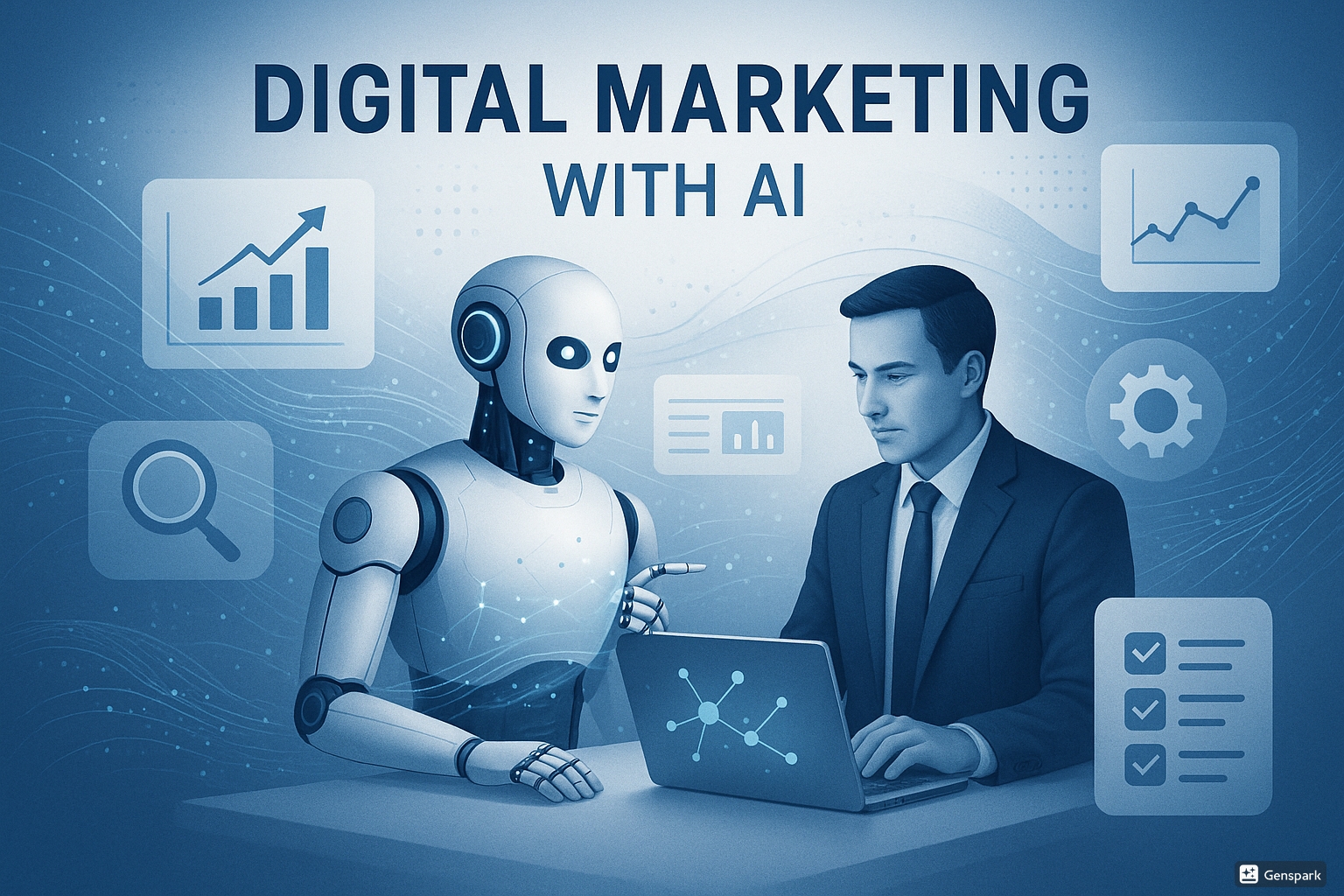
The integration of AI into digital marketing isn't merely a technological novelty; it represents a fundamental shift in how businesses approach their marketing efforts. With 92% of marketers reporting that AI has significantly changed their job roles, we're witnessing a transformation that affects every aspect of the marketing function. This article explores the most impactful ways AI is reshaping digital marketing and provides actionable insights for leveraging these technologies to drive business growth.
The Current State of AI in Digital Marketing
How AI is Transforming Marketing Operations
AI is no longer just a buzzword or future technology—it's actively reshaping marketing departments worldwide. According to recent data, the AI in marketing market is projected to grow at an unprecedented rate, with businesses across sectors integrating AI solutions into their marketing stacks.
"AI is transforming digital advertising by enabling more precise targeting and optimization. Machine learning algorithms can analyze user data to identify the optimal times for displaying ads, the most effective ad formats and the ideal audience segments," notes Deepak Bansal, CEO & Founder of Clearpath Technology. Forbes
The impact of AI extends across all marketing functions, from content creation to campaign optimisation and customer service. With AI's ability to process vast amounts of data quickly and accurately, marketers can now make data-driven decisions with unprecedented precision.
Key AI Marketing Statistics for 2025
- 92% of businesses plan to invest in generative AI over the next three years
- Marketers using AI-powered ad targeting are seeing lower ad costs, higher engagement, and more conversions
- 51% of marketers use AI tools to optimise content, from email campaigns to search engine optimisation
- Brands working with AI-powered content creation see three times better results than those using traditional methods
AI Tools Transforming Digital Marketing in 2025
The digital marketing landscape is now populated with sophisticated AI tools designed to enhance various aspects of marketing strategy. Here's a look at some of the most influential AI marketing tools in 2025:
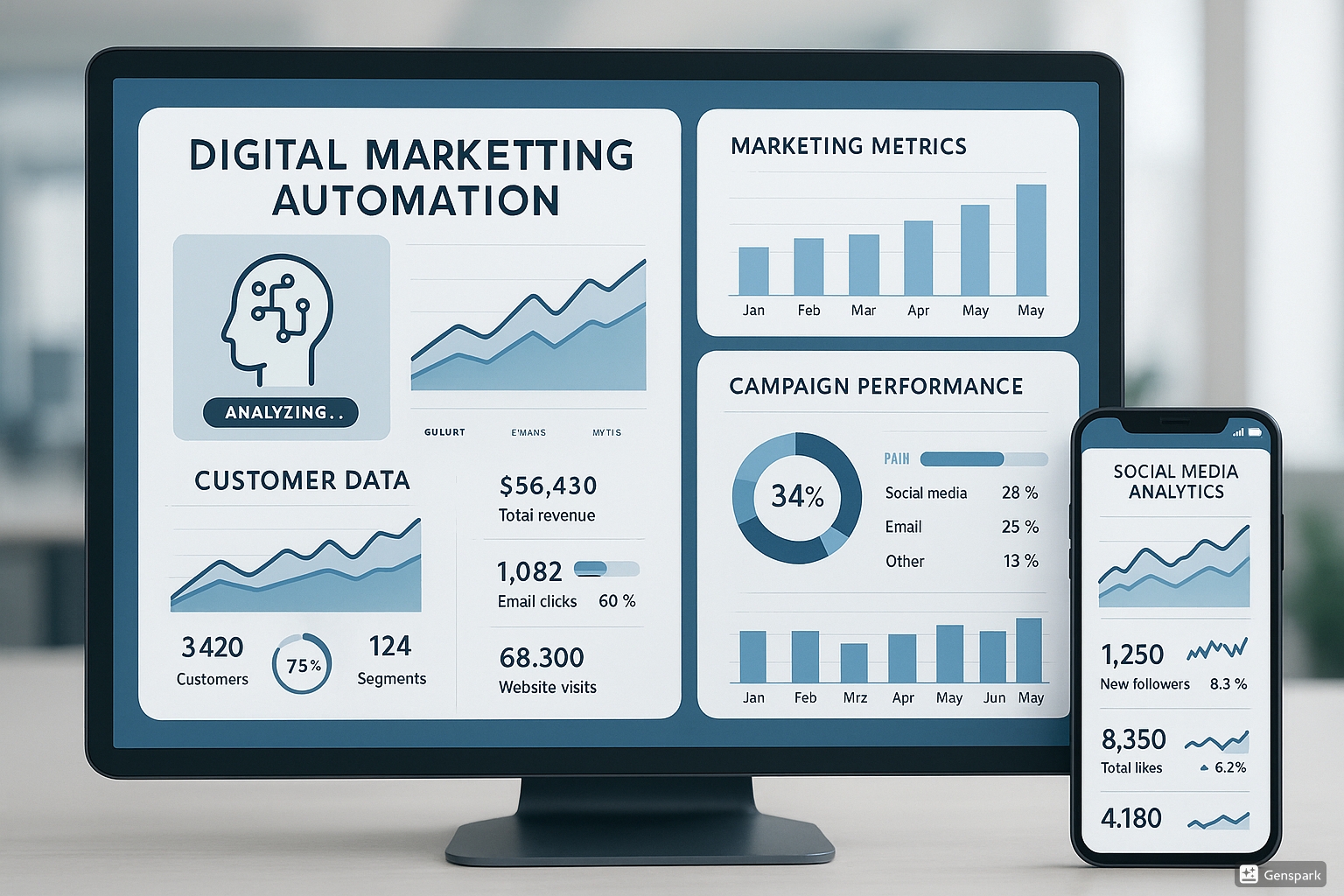
Top AI Marketing Tools Comparison
| AI Tool | Primary Function | Key Benefits | Best For | |
|---|---|---|---|---|
| 0 | ContentShake AI | SEO blog writing | Combines LLMs with SEO data from Semrush for optimized content creation | Content marketers focused on SEO-driven content strategy |
| 1 | Gumloop | AI automation | Connects LLMs to internal tools without coding, built-in premium model access | Marketing teams looking to automate repetitive tasks |
| 2 | Surfer SEO | Content optimization | Real-time SEO scoring, keyword density analysis, readability metrics | Content creators focused on search engine ranking |
| 3 | Jasper AI | Copywriting | Multi-tone content creation, templates for various marketing formats | Marketing teams needing diverse content formats quickly |
| 4 | Albert.ai | Digital advertising | Cross-platform ad optimization, audience discovery, performance tracking | Brands wanting to improve ad campaign efficiency |
| 5 | Undetectable AI | AI content humanization | Rewrites AI-generated content to pass AI detection tools | Content creators concerned about AI content detection |
Key Areas Where AI is Revolutionising Digital Marketing
H3: AI in Content Creation and Optimisation
Content creation has traditionally been a time-consuming aspect of digital marketing. AI is transforming this landscape by generating high-quality content at scale while optimising it for search engines.
"AI can automate and improve keyword research and content optimisation by analysing user behaviour, along with creating meta tags and headings," notes the Digital Marketing Institute.
Tools like ContentShake AI and Jasper AI can now produce blog posts, social media content, and email campaigns that match specific brand voices and target specific keywords—all in a fraction of the time it would take a human writer.
H3: Personalised Customer Experiences
One of the most significant advantages of AI in digital marketing is its ability to deliver highly personalised customer experiences. By analysing vast amounts of data, AI algorithms can understand individual preferences, behaviours, and purchasing patterns.
"By analysing vast amounts of data, AI algorithms can understand individual preferences, behaviours, and purchasing patterns. This allows marketers to tailor content, product recommendations, and advertising to each user, resulting in a more engaging and relevant experience," explains Deepak Bansal. Forbes
This level of personalisation extends beyond simple product recommendations to include customised email content, personalised website experiences, and tailored social media engagement strategies.
H3: AI-Powered Ad Targeting and Optimisation
AI is revolutionising digital advertising by enabling more precise targeting and real-time optimisation. Machine learning algorithms analyse user data to identify optimal times for displaying ads, effective ad formats, and ideal audience segments.
Additionally, AI can automate the bidding process for pay-per-click (PPC) campaigns, adjusting bids in real-time to achieve the best possible results. This level of automation reduces the need for manual intervention, saving time and resources while improving ad performance.
H3: Enhanced Data Analysis and Insights
AI's ability to process and analyse large volumes of data quickly and accurately is transforming how marketers understand their audiences and campaigns. AI-driven analytics tools can sift through data sets in real-time, identifying trends, patterns, and insights that might otherwise go unnoticed.
These insights inform marketing strategies, helping businesses make data-driven decisions. For example, AI can identify which marketing channels are driving the most traffic and conversions, enabling marketers to allocate their budgets more effectively.
H3: Conversational Marketing with AI Chatbots
AI-powered chatbots are becoming increasingly popular as a means of providing efficient and effective customer support. These virtual assistants can answer frequently asked questions, process orders, and offer personalised product recommendations.
Chatbots are available 24/7, ensuring that customers receive immediate assistance regardless of the time of day. This improves customer satisfaction and frees up human agents to handle more complex queries, increasing overall efficiency.
The Future of Digital Marketing with AI
As we look ahead, several emerging trends are set to further transform the AI marketing landscape:
H3: The Rise of First-Party Data and Trust
With third-party cookies disappearing and privacy regulations increasing, first-party data is becoming more valuable than ever. AI helps marketers make the most of this owned data through advanced segmentation and personalisation.
Brands that own their audience through email lists or community platforms are outperforming those relying solely on paid ads. AI tools that can ethically collect and utilise first-party data will become increasingly important.
H3: Social Search and the Changing SEO Landscape
The way people discover content is changing dramatically. According to HubSpot's data, more people are searching on social platforms like TikTok and Instagram than on traditional search engines.
"Google reported a 40% decline in product searches by Gen Z as younger users are shifting their searches to social platforms," reveals HubSpot's marketing report. This shift requires marketers to optimise content for social search, incorporating searchable text into videos and using platform-specific search trends.
H3: Brands as Content Creators
The most successful brands are no longer just selling products; they're creating valuable content that builds trust and keeps customers engaged. AI is facilitating this transformation by helping brands create engaging, educational content at scale.
"92% of marketers are shifting budgets from ads to brand-led content because consumers trust creators over traditional ads," according to recent marketing research. This trend is expected to accelerate as AI makes content creation more efficient and effective.
Implementation Strategies for AI-Driven Digital Marketing
H3: Developing an AI Marketing Strategy
Implementing AI into your digital marketing efforts requires a strategic approach. Here's a framework for developing an effective AI marketing strategy:
- Audit your current marketing processes to identify areas where AI could add value
- Start small with specific use cases rather than attempting a complete transformation
- Focus on the customer experience and how AI can enhance it
- Balance automation with human oversight to ensure brand consistency and quality
- Measure the impact of AI tools on key performance indicators
H3: Overcoming Implementation Challenges
While AI offers numerous benefits, implementing these technologies comes with challenges:
- Data quality and privacy: Ensure you have robust data management practices and compliance measures.
- Integration with existing systems: Work on gradually upgrading infrastructure to support AI tools.
- Skill gaps: Invest in training your team to work effectively with AI technologies.
- Balancing automation and human creativity: Find the right mix for your brand and audience.
Expert Insights on AI in Digital Marketing
In this comprehensive video from HubSpot Marketing, you'll discover the six critical marketing trends reshaping how brands connect with customers in 2025, including the AI marketing takeover, the attention crisis, and the shift to social platform SEO.
Wes McDowell breaks down five brand new digital marketing strategies for 2025, showing how consumer behavior is changing and how businesses can adapt their strategies to the new landscape, with special emphasis on AI implementation.
Conclusion: Embracing the AI-Driven Future of Digital Marketing
As we navigate through 2025, it's clear that AI isn't just a technological advancement in digital marketing—it's a fundamental transformation in how businesses connect with their audiences. From content creation to personalisation, data analysis to ad optimisation, AI is enhancing every aspect of the marketing function.
The most successful marketers will be those who embrace these technologies while maintaining the human creativity and strategic thinking that technology cannot replace. By combining AI's efficiency and analytical capabilities with human empathy and creativity, businesses can develop marketing strategies that are both data-driven and deeply resonant with their target audiences.
As privacy concerns continue to evolve and consumer expectations rise, AI will play an increasingly important role in helping brands navigate this complex landscape. Those who can ethically leverage AI while building genuine connections with their audiences will thrive in this new era of digital marketing.
For businesses just beginning their AI journey, the key is to start small, focus on specific use cases, and gradually expand as you build expertise and confidence. Remember that implementing AI is not about replacing human marketers but about empowering them to work more efficiently and effectively.
The future of digital marketing is here, and it's powered by AI. By embracing these technologies today, you position your business for success in an increasingly competitive digital landscape.
Frequently Asked Questions
H3: How is AI used in digital marketing?
AI is used in multiple ways across digital marketing, including content creation and optimisation, personalised customer experiences, ad targeting and optimisation, data analysis, chatbots for customer service, predictive analytics, and social media monitoring.
H3: Can AI replace digital marketers?
No, AI will not completely replace digital marketers. While AI can automate routine tasks and improve efficiency, human creativity, strategic thinking, and emotional intelligence remain essential. AI is best viewed as a powerful tool that enhances human capabilities rather than a replacement for human marketers.
H3: What are the best AI tools for digital marketing in 2025?
Some of the top AI marketing tools in 2025 include ContentShake AI for SEO blog writing, Gumloop for AI automation, Surfer SEO for content optimisation, Jasper AI for copywriting, Albert.ai for digital advertising, and Undetectable AI for content humanisation.
H3: How do I measure the ROI of AI in my marketing strategy?
Measure AI's impact by tracking key performance indicators before and after implementation, such as content production time, conversion rates, click-through rates, customer acquisition costs, and customer lifetime value. Compare these metrics against your investment in AI tools to calculate ROI.
H3: What skills do marketers need to work effectively with AI?
Marketers should develop a basic understanding of AI concepts, data analysis skills, critical thinking abilities to interpret AI insights, adaptability to evolving technologies, and ethical considerations around AI use. Additionally, creativity and emotional intelligence become even more valuable in an AI-powered marketing environment.
H3: How can small businesses implement AI in their marketing strategy?
Small businesses can start with user-friendly AI tools that address specific pain points, such as content creation tools like Jasper AI or SEO optimisation tools like Surfer SEO. Start with free trials or lower-cost options, focus on one area at a time, and scale as you see results and build confidence.


